
Preservation Breast Augmentation
Is this new approach hype or the future of breast augmentation surgery?
Key Takeaways
- Preservation breast augmentation is designed to enhance breast shape while preserving natural anatomy, support structures, and movement.
- By minimizing tissue disruption, preservation breast augmentation may offer faster recovery and more natural-looking results than traditional techniques.
- The technique reflects a broader shift in aesthetic surgery toward anatomy-based, minimally invasive procedures that prioritize individualized outcomes.
Breast augmentation has been one of the most common plastic surgery procedures for years, but little has changed since fifth-generation silicone gel-filled implants made by US manufacturers were approved by the US Food and Drug Administration 20 years ago.1 That is finally changing, and I have never experienced such excitement and anticipation surrounding a breast enhancement procedure as I am now.
Preservation breast augmentation has gained significant attention across social media, surgical meetings, and patient conversations, raising the question: is this truly a meaningful innovation that will change the future of breast augmentation, or is it simply the latest trend receiving disproportionate attention?
THE PRESERVATION BREAST AUGMENTATION PROCEDURE
Preservation breast augmentation works with the breast’s existing anatomy instead of cutting through it or working against it. The implant is placed in the natural plane below the breast gland and above the pectoralis fascia. The muscle is protected and stays in its natural position. None of the ligamentous structures that support the breast are disrupted. The result is an augmentation that holds its shape, recovers faster, and leaves the internal architecture intact.
The procedure is performed under either local anesthesia with sedation or general anesthesia. That choice depends on the patient and the clinical picture. The fact that the internal tissues are not cut makes the procedure much more comfortable.
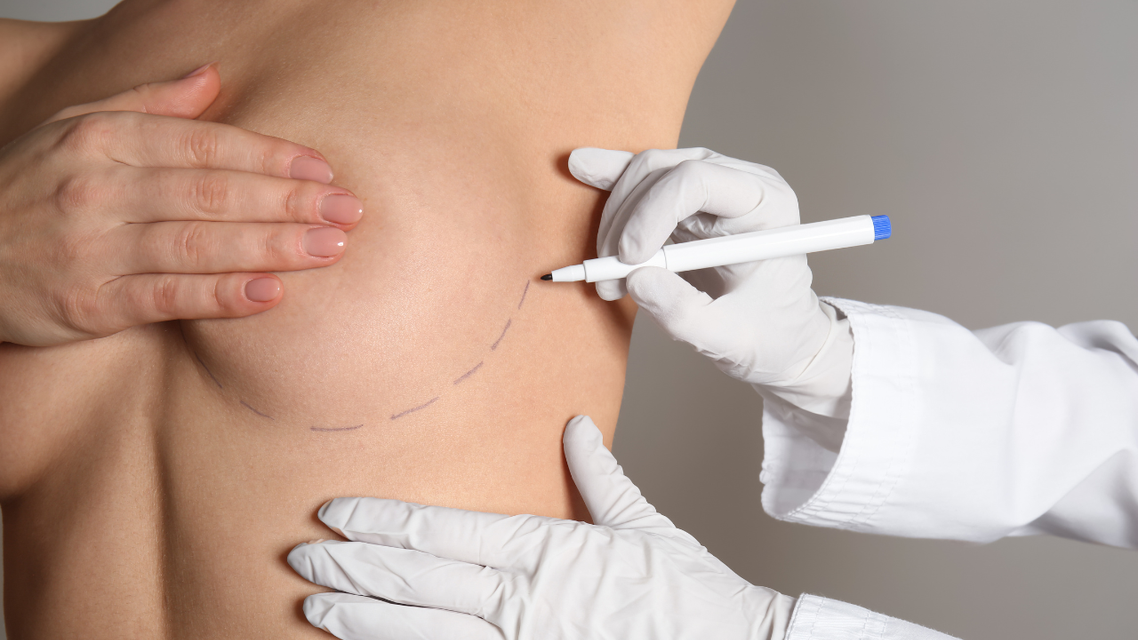
Marking the patient is critical as it determines the position in which the breast implant is placed. We outline the native breast footprint and the intended implant position. In most cases I want the implant sitting slightly higher and more medial than the natural footprint, because that placement is what creates cleavage and upper pole fullness with a smaller implant.
The incision is placed at the inframammary fold and is typically 2 to 3 cm. The tumescent cannula is placed in the space below the breast gland, above the pectoralis fascia. The use of ultrasound leads to precision placement of the numbing solution in the proper position. The solution does simultaneously gently expands the space and it keeps the patient comfortable through the rest of the procedure. I wait a few minutes for the solution to take effect before moving on.
Next, I advance a specialized channel guide through the same incision, creating a defined pathway up toward the upper breast. This is where the technique departs from a traditional augmentation. No cutting. No cautery. Instead of dissecting through tissue, I place a balloon expander into the pocket and inflate it slowly to the target volume. The balloon opens the space while the surrounding ligaments stay exactly where they were. The ligamentous structures are the breast’s internal support system.
Once the pocket is the right size, the balloon comes out and the implant goes in through the incision with the use of a funnel into the channel that has already been formed. Because the tissues have not been cut or cauterized, they close naturally around the implant and hold it in a stable position. The incision is closed in layers. The resulting incision is typically between 2 and 3 cm, hidden at the breast fold.
The concept of breast preservation is a focus on shape, not size. The breast moves naturally because the structures responsible for that movement of the breast have not been touched. Recovery is typically faster as there is less disruption to the breast tissues and surrounding anatomy.
THE IMPACT OF PRESERVATION BREAST PROCEDURES
Although it is still early and the field continues to evolve, this approach has become a mainstay of breast enhancement in our practice.
A closer examination of preservation breast procedures reveals that this approach reflects both current patient expectations and the broader direction of aesthetic medicine. Patients want natural-looking results. They want rapid recovery. They want longevity. They want options that align with their anatomy and fit into their lifestyle. Aesthetic medicine is shifting toward a minimally invasive treatment paradigm. The world of medspas, wellness, and surgery is no longer divided into separate domains; instead, it exists along a continuum. Injectable breast augmentation exemplifies this convergence, which may explain the rapid adoption of these techniques.
The modern breast augmentation consultation differs substantially from what it was in the past. Multiple factors contribute to this shift, including the widespread use of GLP-1 receptor agonists for weight loss and the growing influence of artificial intelligence (AI) in helping patients identify appropriate practitioners.2,3 Today’s patients often seek enhancement that is restorative rather than transformative. They desire a fit, feminine, and natural appearance, with improved fullness, shape, and confidence, while avoiding an over-augmented look. Many patients wish to increase fullness without increasing overall breast size (a historically challenging goal). They also want less downtime, less disruption, and a procedure that aligns with their existing health and wellness routine.
This represents a pivotal shift in plastic surgery. Historically, traditional augmentation techniques were built around the limitations of available implants. Earlier generations of implants, particularly saline ones, frequently required surgical approaches that compensated for implant characteristics rather than complementing the patient’s natural anatomy. Submuscular augmentation, or “half under the muscle,” as described by Kylie Jenner,4 has served many patients well, but technology and anatomical understanding have advanced, leading to the evolution of surgical techniques.

PRESERVATION OVER DISRUPTION
The concept of preservation breast augmentation is simple but powerful: preserve the natural anatomy of the breast and work within it rather than disrupting it. This allows us to achieve more with less intervention. It allows the surgeon to use the patient’s existing anatomical architecture to enhance shape instead of concealing the implant, which has resonated strongly with both patients and surgeons. The idea of maximizing outcomes with minimal disruption has helped reshape approaches to breast enhancement procedures—and, in my opinion, may influence the broader aesthetic industry.
Instead of aggressively creating a surgical pocket by cutting and dividing tissue, preservation techniques are designed to work within a native anatomical plane that sits underneath the breast tissue and above the muscle and fascia. It is not subglandular, not subfascial, and not dual plane; rather, it represents a distinct anatomical space that allows us to enhance the breast while respecting surrounding structures.
Why does this distinction matter? When you preserve the natural ligaments, tissue support, and boundaries of the breast, you are not just placing an implant; you are working with the breast in a way that allows the implant to integrate more naturally into the existing anatomy. It enhances native tissue support. It allows the breast to move and flow naturally as it did prior to the augmentation and allows the implant to become part of the natural breast movement instead of disrupting it.
One of the most exciting parts of preservation breast augmentation is how precisely the space can be developed with minimal disruption. Using ultrasound guidance, tumescent fluid is placed into this anatomical plane, allowing the tissues to separate in a controlled and gentle way. This helps define the space while minimizing tissue trauma. It is one of the reasons the procedure can often be performed through a small incision and under lighter anesthesia or sedation.
This minimally invasive and less-downtime approach is a major reason why patients have responded so strongly to it. From a surgical perspective, however, the real excitement extends beyond the incision size or recovery. The greatest advantage is preservation of natural support structures of the breast, particularly the circummammary ligaments and surrounding tissues that define the breast footprint. These structures are essential for shape, support, and potentially long-term outcomes, though data are limited as of now.
One of the fundamental concepts behind preservation breast augmentation is that the implant is not sitting in a widely dissected space. With so much of the natural tissue support preserved, the implant is held within the breast in a more harmonious way. Rather than forcing the breast to conform to the implant, the implant complements the native breast—representing a significant conceptual shift.
With traditional dissection, tissue is released and the implant often fills the space that has been surgically created. With preservation techniques, we can maximize the patient’s native breast tissue and place the implant more strategically to fill areas where fullness is lacking, rather than over-augmenting the entire breast.
This is why these results can feel softer, more natural, and more aligned with the patient’s body. This likely explains why this technique has resonated so strongly with patients who want enhancement that moves with them rather than something that feels artificially placed.
A MORE MANAGEABLE RECOVERY
Patients today place significant value on the overall treatment experience, not solely on the result. Many women are interested in breast enhancement but must balance careers, exercise routines, family schedules, travel, and other responsibilities. The busy business professional represents a key demographic attracted to this procedure. A long, disruptive recovery remains one of the primary reasons they hesitate to pursue aesthetic surgery.
Preservation breast augmentation has changed that conversation. Because the technique is designed to minimize tissue disruption, recovery has often been faster and more manageable among my patients than many expected. Smaller incisions, precise pocket development, lighter anesthesia, and preservation of the natural anatomy all contribute to this improved experience.
A NEW WAY OF THINKING
I strongly believe this is one of the most important changes we have seen in breast augmentation in years; however, that does not mean traditional augmentation is going away. It continues to play a significant role and remains an excellent option for many patients.
Preservation techniques have introduced a new way of thinking about breast enhancement—one that is much more anatomy-based, patient-specific, and aligned with modern expectations. It has expanded the market to patients who may not have previously considered breast enhancement.
This is not about chasing hype or following trends. It is about recognizing when innovation addresses what patients have been seeking in a breast enhancement procedure. Patients want natural results, less downtime, and implants that move with their bodies. They seek refinement rather than excess and value individualized options.
Preservation breast augmentation speaks directly to a group of patients who previously felt underserved. It has changed the way many surgeons approach breast augmentation procedures.
I believe this shift represents only the beginning. We are at a pivotal moment in plastic surgery, with the opportunity to shape the future of breast enhancement.
As implant technology continues to improve and understanding of anatomy and technique advances, further evolution in breast augmentation is expected. Preservation procedures are part of a broader movement in aesthetic surgery toward respecting natural anatomy, minimizing disruption, and creating results that feel more individualized.
1. Kaoutzanis C, Winocour J, Unger J, Gabriel A, Maxwell GP. The Evolution of Breast Implants. Semin Plast Surg. 2019 Nov;33(4):217-223. doi: 10.1055/s-0039-1696985. Epub 2019 Oct 17.
2. Nahabedian MY, Deva AK, Ahmed D, Fanzio P, Hammer J. GLP-1 Receptor Agonist-Associated Weight Loss and Aesthetic Breast Surgery: A Narrative Review and Experience-Based Recommendations for Plastic and Reconstructive Surgeons. Aesthet Surg J Open Forum. 2026 Mar 28;8:ojag054. doi: 10.1093/asjof/ojag054.
3. Zeng W, Schroeder A, Moyer K, Thompson J. Augmentation AI: Use of a Novel Deep Learning-Based Generative Artificial Intelligence System As a Tool for Breast Augmentation Simulation. Aesthet Surg J Open Forum. 2025 May 13;7(Suppl 1):ojaf018.019. doi: 10.1093/asjof/ojaf018.019.
4. Fargo M. Kylie Jenner Gets Real About Her Breast Augmentation—Down To The Implant Size. Vogue. Published June 3, 2025. Accessed April 20, 2026. https://www.vogue.com/article/kylie-jenner-breast-augmentation-details
Ready to Claim Your Credits?
You have attempts to pass this post-test. Take your time and review carefully before submitting.
Good luck!
Recommended
 MAY-JUN 2026 ISSUE
The Science of Dual-Wavelength Photobiomodulation
Jordan R. Plews, PhD; Kay Durairaj, MD, FACSJordan R. Plews, PhD; Kay Durairaj, MD, FACS- MAY-JUN 2026 ISSUE
The Science of Hair Aging: Why Hair Turns Gray, Thin, and Fragile
Kay Durairaj, MD, FACS; Madison AttarchiKay Durairaj, MD, FACS; Madison Attarchi