
Modern Deep-Plane Facial Rejuvenation
A strategy to minimize pain and downtime while achieving a natural appearance.
Key Takeaways
- The MAERCKS LiftTM emphasizes deep-plane facial rejuvenation through ligamentous suspension and composite mobilization of the face and neck.
- The KEDGE SuspensionTM system reanchors native retaining ligaments rather than relying on skin or lateral SMAS tension.
- The Exparel tumescent protocol (incorporating liposomal bupivacaine, bupivacaine hydrochloride, epinephrine, and tranexamic acid) is designed to prevent nociceptive signaling, enabling minimal postoperative pain and downtime.
- The technique can be performed under local or general anesthesia, both of which are associated with minimal pain during recovery and rapid return to daily activities.
Patients seeking aesthetic procedures aim for rejuvenation that is profound yet undetectable, reflecting vitality without altering their identity. Traditional facelifts often rely on skin or lateral superficial musculoaponeurotic system (SMAS) tension, which distorts facial landmarks and yields temporary results.
The MAERCKS LiftTM departs from these paradigms by reestablishing the natural facial framework through ligamentous suspension and deep-plane composite mobilization. This method preserves connective tissue integrity, ensuring durable elevation while maintaining the blood supply.
Complementing this structural philosophy is the Exparel tumescent protocol, a preemptive analgesic system inspired by the gate control theory of pain.1 By saturating peripheral nerves with liposomal bupivacaine before incision, pain signals are never registered by the brain, creating a virtually painless experience.
The MAERCKS LiftTM procedure can be performed under either local or general anesthesia.
TECHNIQUE OVERVIEW
Anatomic Philosophy and KEDGE SuspensionTM
Facial aging results from attenuation of retaining ligaments and descent of deep soft-tissue units. Most deep-plane lifts rely on lateral SMAS anchoring, leaving a span of elastic tissue between fixation and the ligamentous roots, resulting in sweep, laxity, and early relapse.
The KEDGE SuspensionTM directly engages the zygomatic, parotidomasseteric, and mandibular ligaments, restoring the natural vectors of facial support along the same lines established in youth. As a result, the outcome appears rebalanced rather than “pulled.” The surface drape remains harmonious, preserving facial expression and sex-specific contour.
Exparel Tumescent Protocol
An integral element of this strategy, the Exparel tumescent protocol enables the minimal-pain, no-downtime recovery that defines the technique. The protocol creates a localized, sustained-release analgesic field that closes the neural gates described by Melzack and Wall,1 preventing C-fiber transmission and thereby preempting pain.
The typical formulation includes the following:
- Liposomal bupivacaine for anesthesia
- Bupivacaine for immediate bioavailability
- Epinephrine for hemostasis
- Tranexamic acid for platelet stabilization
- Sodium bicarbonate for buffering
The solution is infiltrated into all planned dissection planes before incision, including the subcutaneous plane in the face and neck, the sub-SMAS entry region, the deep premasseteric space, and the submental operative field.
The goals of the Exparel tumescent protocol are to allow hydrodissection of the surgical planes, promote hemostasis through vasoconstriction, and provide prolonged postoperative analgesia (typically ~72 hours). Patients generally do not require narcotic medication after surgery. Narcotic analgesics are typically prescribed as a backup, but patients are strongly encouraged to rely primarily on nonopioid medications.
Deep-Plane Dissection and Glide-Plane Preservation
A key aspect of this strategy is maintaining dissection within the loose areolar glide-plane: the natural potential space between the deep fascia and the SMAS layer. Working in this plane allows the surgeon to elevate the composite unit with minimal disruption to vascular and lymphatic networks. By focusing dissection within this preexisting, low-resistance plane, tissue trauma, swelling, and bruising are greatly reduced, thereby accelerating recovery and minimizing downtime.
Moreover, by retaining the composite monobloc skin, SMAS, and sub-SMAS fascia as a single unit, the natural vector relationships of the face remain intact. This continuity preserves authentic animation, ensuring that expressions remain fluid and identity-specific. The result is rejuvenation that restores the patient’s native structure, rather than a surgically altered facsimile.
Incision Placement and Design
The incision design follows a composite deep plane facelift pattern with attention to preserving natural ear contour and avoiding the appearance of an “operated” face. The incision typically begins within the temporal hairline, following the natural contour of the temporal scalp, and continues inferiorly along the anterior hairline when appropriate. It then transitions into the preauricular crease, maintaining a pretragal or carefully contoured tragal incision depending on the patient’s anatomy and any previous scars. The incision then curves around the lobule and continues in the retroauricular sulcus before extending into the occipital hairline when needed.
Subcutaneous dissection is initially carried out in the traditional superficial plane to the point of deep plane entry. Entry into the deep plane is performed sharply with the SMAS placed under gentle tension. Once the deep plane is entered, blunt dissection proceeds in the sub-SMAS plane using facelift scissors. Care is taken to remain superficial to the facial nerve branches while maintaining the integrity of the SMAS flap.
The retaining ligaments of the midface, particularly the zygomatic and masseteric retaining ligaments, are sequentially identified and released under direct visualization using sharp dissection to preserve their suspensory power and avoid delamination or weakening. Releasing these structures allows the composite flap of skin, SMAS, and associated tissues to be mobilized as a single functional unit. This release is essential for achieving vertical repositioning of the descended malar fat pad and restoring natural midfacial contour.
Suspension is then performed using deep fixation sutures (2-0 Vicryl, Ethicon). These sutures engage the true ligaments and deep soft tissues and secure them to stable structures, such as the deep temporal fascia or periosteal structures in the lateral temporal or preauricular region. The vector of suspension is generally superior and slightly lateral, restoring midfacial support while improving jawline definition. The key principle is that tension is borne by the strong coalesced ligaments rather than the SMAS or skin, allowing the skin to be redraped and closed with complete laxity and zero tension.
Postoperative Analgesic Plan
Intraoperative infiltration with long-acting Exparel is generally followed by nonopioid oral analgesics postoperatively. Narcotic medication is prescribed as a backup but is rarely needed, typically used only to alleviate discomfort from the head wrap. Most patients report little to no postoperative pain due to the prolonged effect of the local anesthetic.
CASE REPORTS
Patient 1
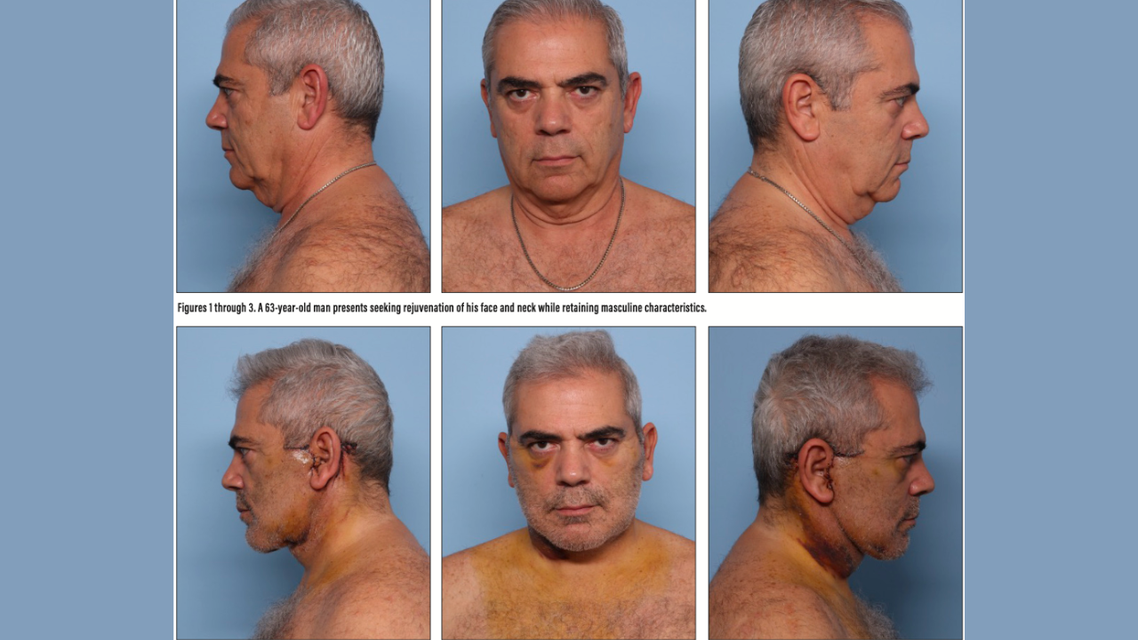
A 63-year-old man (Figures 1 through 3) sought rejuvenation of his face and neck while retaining masculine characteristics. Under general anesthesia with the previously described Exparel tumescent protocol, a composite deep-plane facelift was performed. The patient awoke reporting no pain, required no opioids, and resumed light activity within 48 hours (Figures 4 through 6). Seven days after surgery, he reported that friends had noticed a healthier appearance but no signs that he had undergone surgery (Figures 7 through 9). Follow-up photographs show the outcome at 5 months (Figures 10 through 12) and 7 months (Figures 13 and 14).


Patient 2
A 35-year-old woman presented for preventative rejuvenation with identity preservation (Figures 15 through 17). The procedure was completed under local anesthesia using the previously described Exparel tumescent protocol (Figures 18 through 22). She reported no pain, wore a headband for 2 days, and returned to work the following morning. She continued her normal activities while wearing her hair down.

Even immediately after surgery, the transient widening of the face from the tumescent infiltration is concealed when the hair is down (Figures 23 through 25), with no visible signs of recovery in the central face. Follow-up images at 5 months (Figures 26 through 28) and 7 months (Figures 29 through 31) demonstrate that the central facial structures show minimal recovery; swelling and bruising are confined to the lateral face and are hidden with the hair down.

On day zero, the patient’s face was transformed from long and rectangular to short and heart-shaped. The widening from the tumescent infiltration resolved within 24 hours. At 2 weeks, her appearance is markedly rejuvenated. Because of the ligamentous support, the central facial structures, lips, and nose also appear rejuvenated.
This patient has hereditary malar bags under the eyes and midface, which remain after surgery. These may be addressed in the future with blepharoplasty and lateral reticular suspension. The patient’s live-in partner did not suspect that she had undergone surgery.
DISCUSSION
Although many surgeons describe “deep-plane” facelifts, most continue to rely on lateral SMAS anchoring, which is comparable to pulling a tree’s branches while leaving its roots unmoved. This produces superficial motion, but fails to restore foundational support. Lateral sweep, joker lines, and contrasting low midface and high lateral face—telltale signs of a facelift—may result.
True deep-plane ligamentous support transforms the aging squared face into a more youthful-appearing heart-shaped face, while preserving masculine or feminine characteristics. Patients also demonstrate apparent rejuvenation of central facial structures, including the eyes, nose, and lips, despite a lack of intervention in these areas.
This strategy provides correction at the root level by reanchoring the ligamentous system that governs true facial structure. The result is natural-appearing rejuvenation—restoration rather than redesign. By preserving the composite unit and redraping tissues along their innate vectors, expressions remain authentic and gender-appropriate.
The analgesic protocol extends this structural precision to the sensory experience. By saturating peripheral nerves before incision, the protocol blocks nociceptive impulses at the spinal gate level, preventing pain perception and eliminating the need for postoperative analgesia. All patients reported a pain score of 0 on a 0-to-10 pain scale.
Near zero downtime was achieved, meaning that patients can reenter public and professional life within days after surgery. Women are more likely
to achieve true zero social downtime, because they tend to experience less swelling and bruising than men, and, if they have longer hair, can hide the sides of the face, where early swelling and bruising are most evident. Men typically exhibit some degree of bruising and swelling, although generally less than the male patient presented in this report. Despite his delayed recovery, however, he was able to resume social activities within 7 days with light-coverage tint applied.
Physiologic healing proceeds without visible signs, preserving both privacy and confidence, and allowing seamless continuation of daily activities.
CONCLUSION
The MAERCKS LiftTM, combining KEDGE SuspensionTM with the Exparel tumescent protocol, represents a new paradigm: restoring native structure to achieve a natural appearance with minimal pain, lifestyle disruption, and downtime. By integrating structural anatomy, the neurobiology of pain, and aesthetic principles, the described method enables painless, rapid, and seamless rejuvenation.
1. Melzack R, Wall PD. Pain mechanisms: a new theory. Science. 1965;150(3699):971-979.
2. Mendelson BC, Wong CH, Wu WTL. Anatomy of the facial glideplanes, deep-plane spaces, and retaining ligaments: a study of 50 cadaver heads. Plast Reconstr Surg. 2024;153(1):20-36.
3. Roostaeian J, Hamra ST. Vectorial analysis of the deep-plane face and neck lift. Aesthet Surg J. 2024;44(10):1015-1028.
4. Steinbacher DM, et al. Deep-plane facelift under tumescent anesthesia: review of the last five years. J Plast Reconstr Aesthet Surg. 2023;76(8):1574-1583.
5. Exparel clinical data and prescribing information. Pacira BioSciences Inc.; 2024.
Ready to Claim Your Credits?
You have attempts to pass this post-test. Take your time and review carefully before submitting.
Good luck!
Recommended
 MAY-JUN 2026 ISSUE
The Science of Hair Aging: Why Hair Turns Gray, Thin, and Fragile
Kay Durairaj, MD, FACS; Madison AttarchiKay Durairaj, MD, FACS; Madison Attarchi